Inspection
Defines what was checked, where it was checked and which template version governed the work.
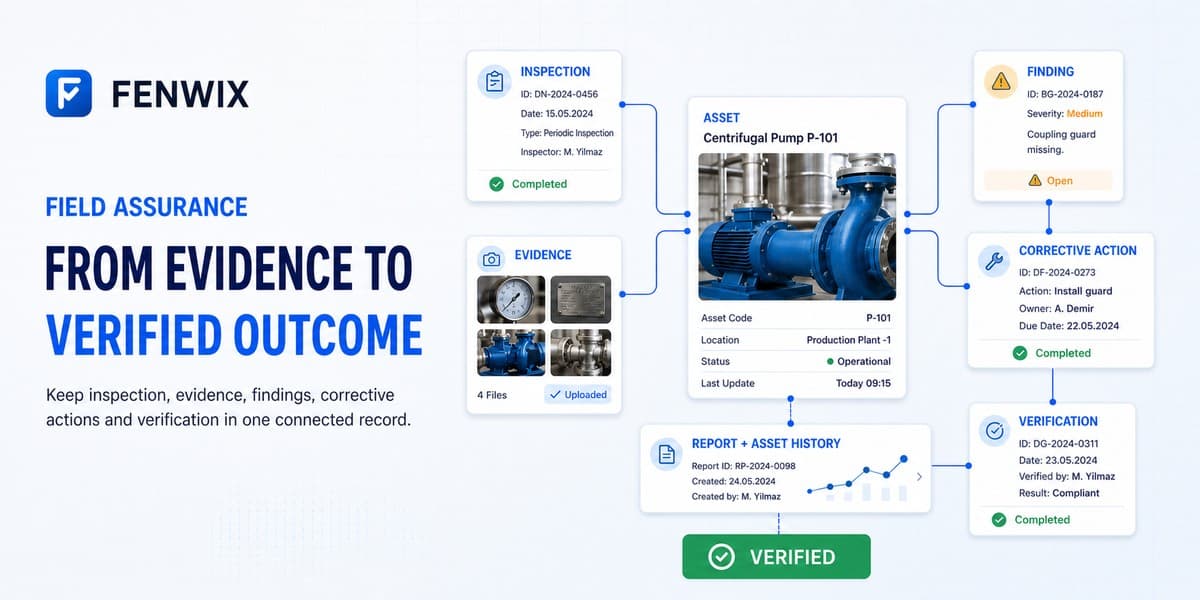
Field Assurance
Field Assurance is an operating approach that shows not only that field work was inspected, but also what evidence existed, what failed, what action followed, whether closure was verified and how the history was preserved.
Completing a form on a phone digitizes data entry. The process remains fragmented if it cannot show which evidence supported an answer, what followed a failure, how a correction was assessed, how the asset history changed or whether a completed record was later revised.
Field Assurance closes that gap through a connected record chain rather than one isolated feature.
Defines what was checked, where it was checked and which template version governed the work.
Preserves the photo, note, audio, source, time and supported location context behind the answer.
Turns a failed answer into a traceable record with risk and operational context.
Connects the required work, responsibility, due date, emergency measure and root-cause context.
Separates submission of correction evidence from the decision to close the finding.
Shows the condition of the inspected asset over time instead of treating every form as an isolated event.
Preserves revisions, summary results, open actions and a portable human-readable output.
| Checklist | Field Assurance |
|---|---|
| Records an answer | Connects the answer to supporting evidence |
| Marks a failure | Turns the failure into corrective action |
| Stores an after-photo | Separates evidence submission from verification |
| Keeps each form separately | Builds asset history over time |
| Shows the latest file | Preserves revision and source-record context |
| Generates a report | Treats the report as an output of the operational record |
This is a Fenwix assessment framework. It is not a certification scheme or an independent industry standard.
The process is distributed across paper, messages, email and personal photo galleries.
The form is completed digitally, but operational relationships remain limited.
Standard templates, answer states, findings and consistent report fields are used.
Evidence, risk, responsibility, timing, corrective action and closure are connected in one record.
Inspections, findings and service state form a history for the inspected asset.
Revision, verification, policy, authorization, retention and audit history are managed at organizational scale.
Customer-controlled data, enterprise integration, governance and field operation form one architecture.
Fenwix Solo currently supports digital capture, structured inspection, evidence and corrective action, and asset-history layers. Revision and source-record verification provide selected record-integrity elements associated with governance.
Customer-controlled shared storage, enterprise authorization, multi-device collaboration, cryptographic signing and Customer Relay are not current Solo capabilities. They belong to the clearly labeled architecture direction and roadmap described on fenwix.net.
Not exactly. Quality assurance is a broader management discipline. Field Assurance focuses on the chain connecting physical field work to inspection, evidence, correction, verification and history.
Field Assurance is used here as a Fenwix product and operating category. The maturity model on this page is not an independent certification standard.
Collecting answers alone is insufficient. The system must also preserve evidence, findings, corrective actions, verification, asset history and revision context.
Fenwix Solo provides important operational layers of the field chain today. Field Assurance OS is the long-term direction that also includes customer-controlled data and enterprise governance.
Start with 24 hours of free local work and one free report output every 24 hours. Eligible users can try Pro for 3 days.