Prevent the fall first
Prefer eliminating height exposure and collective protection before relying on personal fall systems.
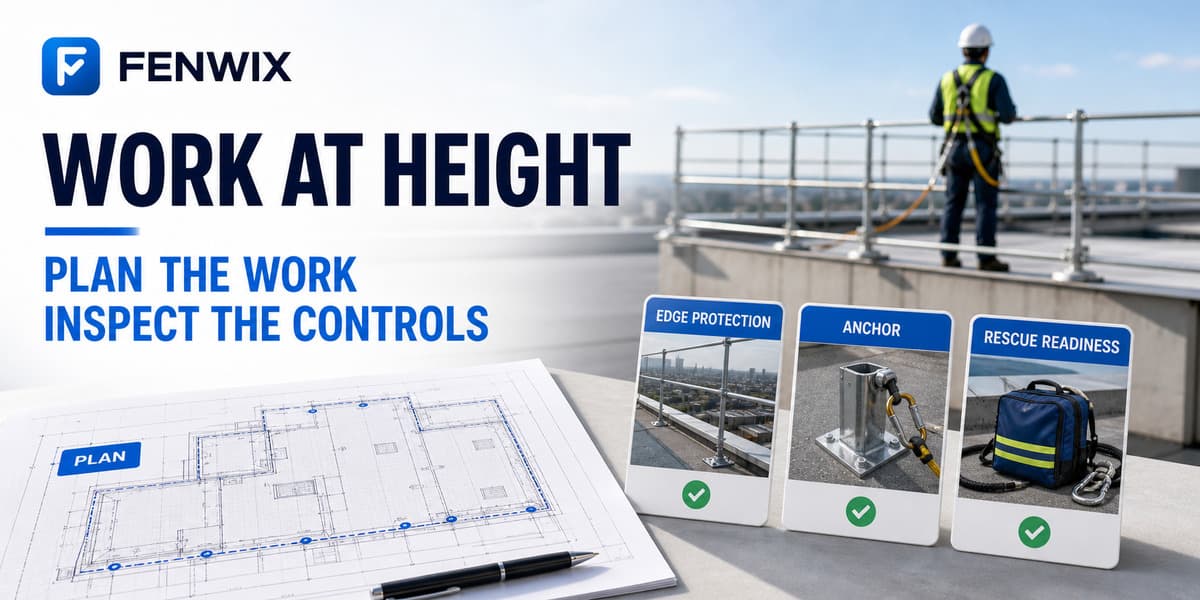
Practical checklist
CURRENTUse this working-at-height checklist to review whether the task is planned, access is suitable, edges and openings are controlled, equipment is fit for the intended system, falling objects are managed and rescue is realistic. A competent person must select controls for the actual height, surface, duration and environment.
Prefer eliminating height exposure and collective protection before relying on personal fall systems.
Access, anchor, connector, user, clearance and rescue must work together.
Weather, layout, simultaneous work and damaged equipment require reassessment.
A harness alone is not a work-at-height plan. Confirm the task can be avoided or redesigned, choose collective measures where practicable, and define supervision, exclusion and rescue before exposure begins.
Record the work face and control arrangement, not only a close-up of a lanyard. Note the exact edge, opening, anchor or access point and capture any immediate stop-work control.
These prompts support a field review; they do not choose equipment, calculate clearance or approve anchors.
Can the work be completed from ground level, prefabricated or otherwise redesigned to remove height exposure?
Is the actual task, location, method, people, duration and control plan understood and authorized before work begins?
Are workers trained for the selected system and supervised at a level appropriate to the task and change risk?
Is access secured, stable, unobstructed and suitable for tools, materials and emergency descent?
Are unprotected edges, floor openings, fragile surfaces and changes in level eliminated, covered, guarded or otherwise controlled?
Is the selected ladder, platform, scaffold or powered access equipment suitable, visibly serviceable and used within its intended conditions?
Where used, are harness, connectors, lanyard or lifeline compatible, inspected and arranged to limit free fall and swing hazards?
Has a competent person confirmed the anchor and required clearance for the complete fall system and work position?
Are tools, materials, toe boards, tethering, storage and exclusion controls preventing exposure below?
Are wind, rain, ice, heat, visibility, nearby electricity and moving plant within the planned safe limits?
Can a suspended or injured person be reached and recovered promptly with available people, equipment and communication?
Are workers expected to stop and reassess after equipment damage, weather change, altered access or conflicting activity?
No. The complete system includes task design, anchor, connectors, clearance, swing risk, user competence and rescue.
No. Suitability depends on the task, duration, load, access, stability and applicable requirements.
Changed weather, access, equipment, work sequence, personnel, surrounding operations or any damage should trigger reassessment.
Yes. Notes and photos can be attached to the relevant checklist result in the current local workflow.
Confirm the task, collective and personal controls, environment and rescue together; stop work when one part no longer matches the plan.
Use this checklist in FenwixContent status: CURRENT · Last reviewed: 2026-08-16
Claim basis: Fenwix independently authored field checklist content · Fenwix current application flow · Fenwix editorial accuracy standard