Observe the condition
Record what is present at the time of the walk, not only what a procedure says should exist.
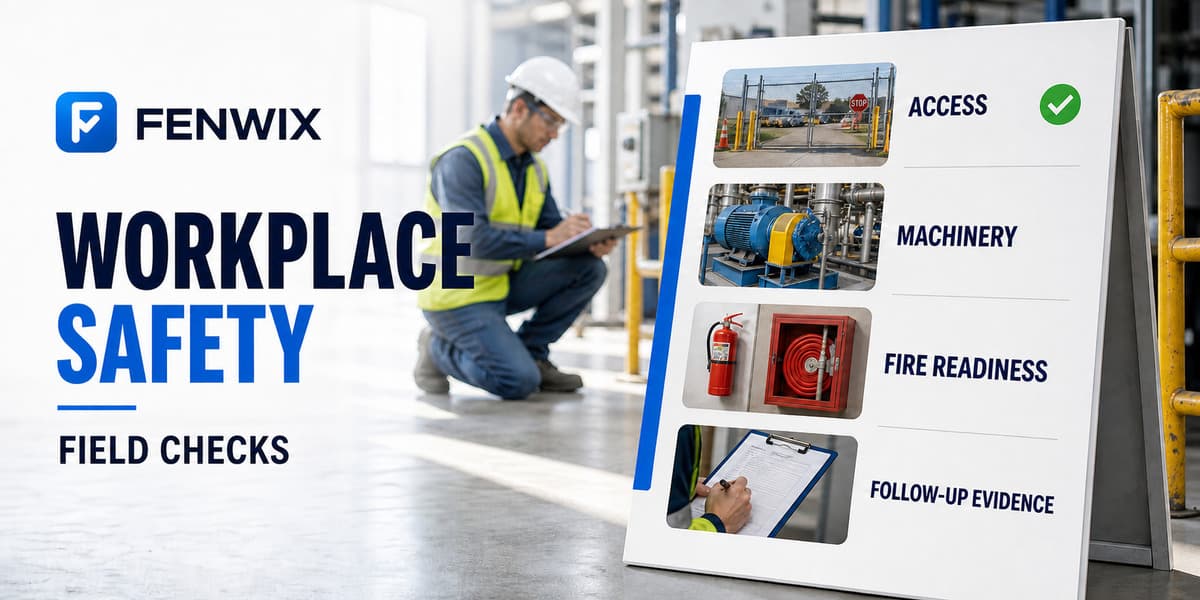
Practical checklist
CURRENTThis workplace safety checklist is a practical starting point for a routine site walk. It covers access, housekeeping, emergency readiness, machinery, electricity, work at height, traffic and welfare. Adapt every item to the actual hazards, legal duties, procedures and competent-person requirements of the workplace.
Record what is present at the time of the walk, not only what a procedure says should exist.
Combine an overview, a detail view and a factual note when a condition needs follow-up.
Give each material finding an owner, due date, completion evidence and verification step.
Define the areas, activities and shift conditions in scope. Review open findings and recent changes, then involve people who understand the work. A generic checklist should never hide a site-specific hazard.
Describe the observed condition, its exact location and the immediate exposure. Avoid vague labels such as unsafe area. Add evidence that lets another person find the issue and understand what must change.
Use these prompts as independently authored field questions. Add, remove or tighten them for the actual risk profile and applicable requirements.
Are walkways, stairs, doors and emergency routes clear, stable, adequately lit and usable without climbing over materials?
Are floors free of spills, trailing leads, loose packaging, sharp waste and other trip or slip hazards?
Are alarms, emergency contacts, assembly arrangements and first-aid locations visible and understood for the work in progress?
Are exits, fire doors, extinguishers and alarm points accessible, identified and free from obvious damage or obstruction?
Are guards, interlocks, emergency stops and exclusion zones present and not visibly bypassed or defeated?
Are plugs, cables, enclosures, temporary boards and panels free from exposed parts, damage, heat signs or unsuitable use?
Are edges, openings, access equipment, falling-object controls and rescue arrangements suitable for the task underway?
Are routes, crossings, reversing areas, visibility controls and separation measures clear and being followed?
Are containers identified, closed and stored compatibly, with spill response and required handling information available?
Is task-appropriate PPE available, serviceable, correctly used and supported by higher-order controls rather than treated as the only measure?
Are drinking water, sanitation, rest areas, ventilation, lighting, temperature and noise conditions reasonably controlled?
Have new contractors, temporary work, changed layouts, isolated equipment and simultaneous activities been communicated and controlled?
Frequency should follow the hazards, rate of change, legal requirements and previous findings. A fixed generic interval is not suitable for every workplace.
Use people competent for the hazards and scope, and involve workers who understand the actual task.
No. Record good practice and neutral observations separately where useful; create a finding when the condition requires action.
Yes. Recreate or adapt the independently authored questions in a Fenwix template and attach evidence and follow-up to each result.
Adapt these prompts to the site, record evidence while the condition is visible and verify each material correction before closure.
Use this checklist in FenwixContent status: CURRENT · Last reviewed: 2026-08-16
Claim basis: Fenwix independently authored field checklist content · Fenwix current application flow · Fenwix editorial accuracy standard